

5 Processes You Can Automate Starting Today
A practical checklist for any business: from processing incoming inquiries to generating reports. No complex implementation or huge budgets required.

Article author
Alexander Chigrinov
Founder of «CHIGRINOV». Works on business automation, implements AI into business processes and oversees solution development by the team.
Message in Telegram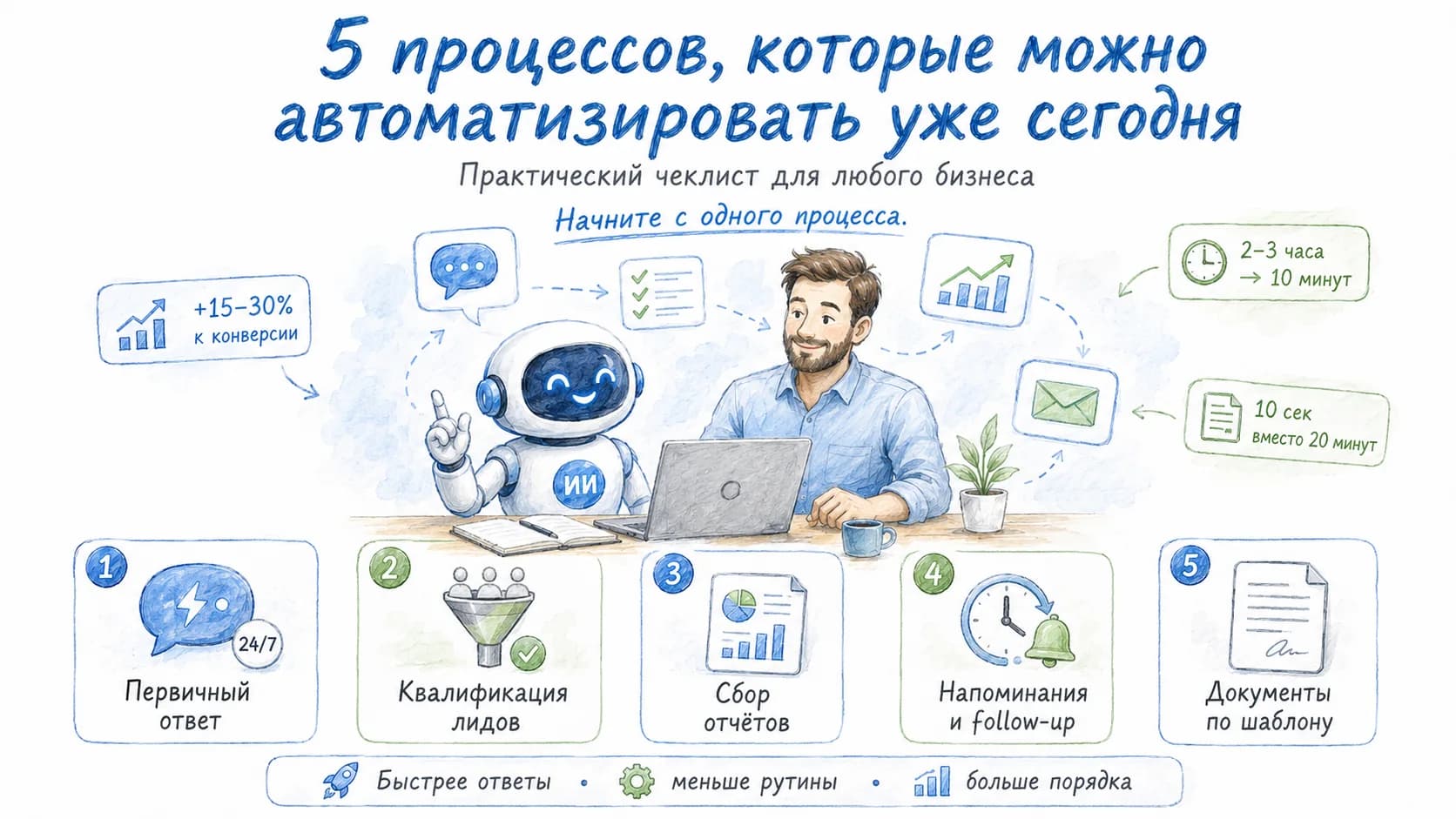
Automation is intimidating in scope. It seems like you need to redo everything at once: CRM, accounting system, processes, train all employees. In reality, it's enough to start with one process.
Here are five processes found in most businesses that are well-suited for automation — quickly and without radical restructuring.
1. Initial Response to Incoming Inquiries
How much time passes from when a client submits an inquiry to the first response? If it's more than 15 minutes — you're losing leads. At that moment, the client is already writing to a competitor.
What to automate: an auto-reply that goes to the client immediately after submission. Not a template "we received your inquiry," but a personalized one — with the client's name, confirming the specific request, with an expected response time.
Tools: Telegram bot, webhook + CRM, a simple script based on your messenger's API.
Result: the client feels heard. Conversion from inquiry to contact grows by 15-30%.
2. Lead Qualification
Are your managers spending time on people who will never buy? On those just comparing prices without a budget? On competitors monitoring your offers?
What to automate: a qualification dialogue — a series of questions that help determine how ready a client is to buy. The bot asks questions, the system evaluates the answers, and decides when to involve a live manager.
Tools: LLM bot (GPT-4o or Claude) with defined qualification criteria, CRM integration.
Result: managers only work with hot leads. Their conversion to sales grows 2-3x.
3. Collecting and Structuring Reports
If your team writes reports in free form every week or every day — in a messenger, email, or spreadsheet — you're likely spending hours consolidating them into a comprehensible format.
What to automate: report collection through a bot (it asks questions, the team responds), automatic structuring, and generating summary dashboards or management reports.
Tools: Telegram bot + LLM for parsing free text + Google Sheets or Notion for storage.
Result: 2-3 hours of management work per week turns into 10 minutes.
4. Reminders and Client Follow-ups
How many potential deals are stuck in "thinking it over" status? How many clients said "call back in a week" and the manager forgot? How many orders are incomplete because a client didn't send the required data?
What to automate: automatic scheduled reminders. A client enters "thinking" status — after 3 days they get a message. An order is awaiting data — after a day the client receives a reminder.
Tools: CRM triggers + Telegram/WhatsApp broadcast or email, cron jobs.
Result: 10-20% of deals that would otherwise be lost are recovered. Managers stop being "reminder secretaries."
5. Document Generation from Templates
Invoices, contracts, commercial proposals, acts — if a manager spends 15-30 minutes creating each document by manually entering data, that's a direct candidate for automation.
What to automate: document generation from CRM data. Click a button — the document is formed, sent to the client, attached to the deal.
Tools: templates in Google Docs + Apps Script, or specialized services integrated with your CRM.
Result: each document is created in 10 seconds instead of 20 minutes. Errors from manual entry disappear.
How to Choose Where to Start
Ask yourself three questions for each process:
- How many hours per week does this take? (If less than two — it can wait.)
- How repetitive is this process? (The more uniform — the better for automation.)
- What happens when this is done poorly or with delay? (If money or clients are lost — high priority.)
Start with the process that scores highest across all three criteria. Automate it. Make sure it works. Only then move to the next one.
Gradual automation is less risky and more sustainable than trying to redo everything at once.
We help implement automation and AI into business processes
In a short audit, we review your task, identify first scenarios and estimate where automation can produce measurable value.
We reply within 2 hours
Need automation? Get a free audit
We'll analyze your processes, find automation opportunities and estimate ROI — in 24 hours, no commitment.