

AI in Small Business: Myths and Reality in 2024
Artificial intelligence is expensive, complex, and only for corporations. That's what most small business owners think. Let's figure out what's actually true.

Article author
Alexander Chigrinov
Founder of «CHIGRINOV». Works on business automation, implements AI into business processes and oversees solution development by the team.
Message in Telegram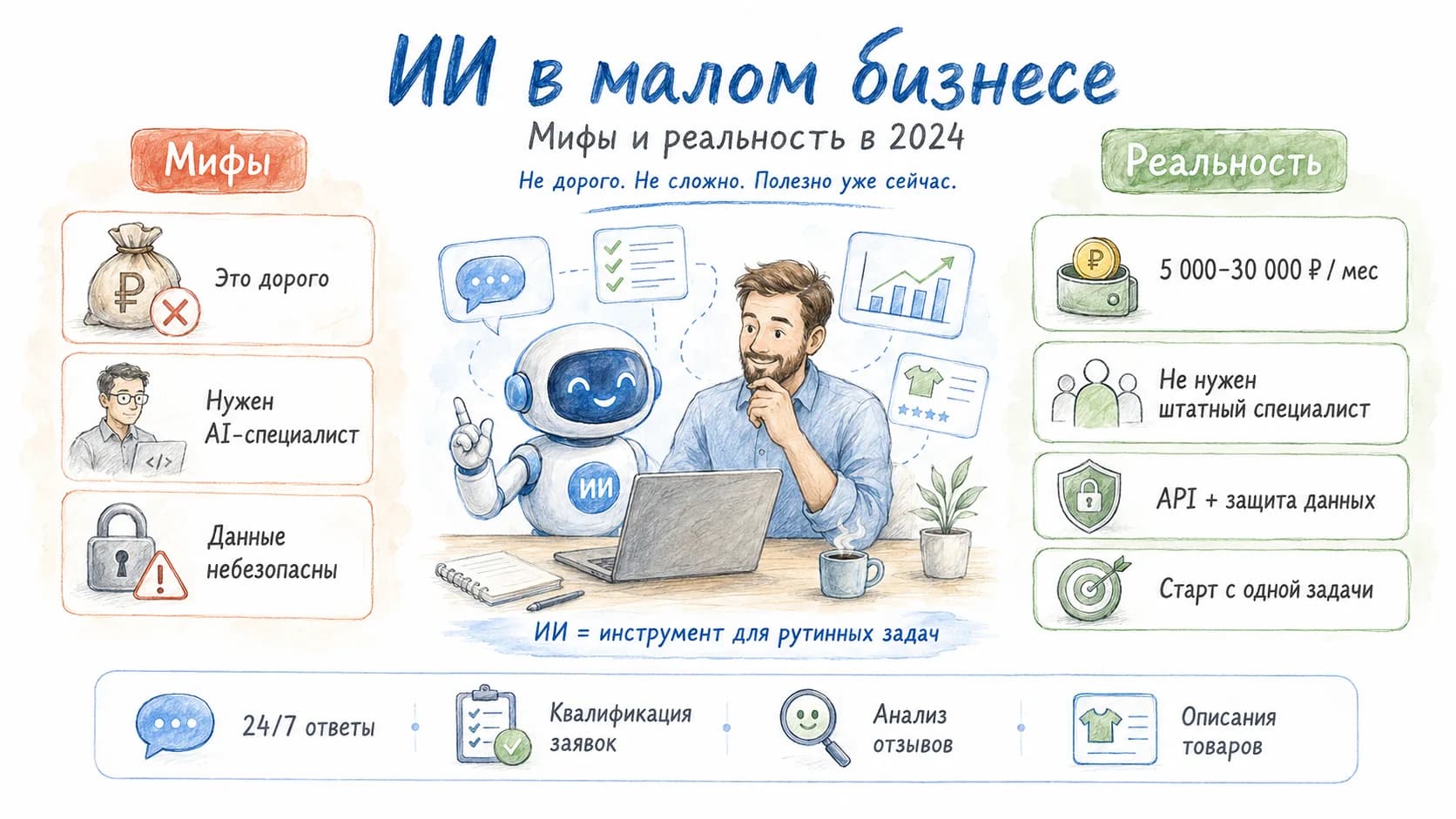
When a small business owner hears "AI," they think of something from science fiction: robots replacing all employees, million-dollar budgets, teams of scientists. Reality is quite different.
Myth 1: "AI Is Expensive"
The most expensive part of an AI implementation is the development work. But the models and APIs themselves are now available by subscription for a few thousand rubles per month. OpenAI GPT-4o, Claude, Gemini — all accessible via API, with the cost of processing one request being fractions of a ruble.
What actually затраты money is customization for your processes, integration with existing systems, and interface development. But these are one-time затраты. Ongoing AI operating expenses for a small business are typically 5,000–30,000 rubles per month — depending on volume.
Compare that to the salary of one employee who could do the same work manually.
Myth 2: "You Need an AI Specialist on Staff"
No. You use online banking without a network engineer on staff. You use accounting software without hiring an ERP developer. AI tools, implemented properly, work like any other service — you pay for results, not infrastructure maintenance.
The only thing required from you is understanding your own processes and willingness to describe the task. Everything else is the integrator's job.
Myth 3: "AI Will Steal Our Data"
This is the most common fear, and it's not without merit — but only if the implementation is done incorrectly. Let's look at the actual picture.
OpenAI, Anthropic, and other providers have clear terms for business clients (API): your data is not used for model training unless you've explicitly consented. Data is transmitted over an encrypted channel.
Moreover, for critically sensitive data, you can configure local deployment or use models that run on your server without transmitting data to external networks. This is more expensive, but the option exists.
- Don't transmit client personal data directly to LLMs without anonymization.
- Use APIs, not web interfaces of services — business API privacy terms are stricter.
- Work with an integrator who explains where and how data is stored.
Myth 4: "AI Makes Mistakes, It Can't Be Trusted"
True: AI makes mistakes. Especially in tasks requiring 100% accuracy in factual data or mathematical calculations. But let's think about how we typically use AI in business.
Lead qualification — doesn't require absolute precision, needs good accuracy. Initial client responses — needs clarity and politeness, not flawless grammar. Review analysis — needs to identify trends, not quote every review verbatim. Application classification — needs 80-90% accuracy, which AI easily delivers.
In tasks where AI errors are truly unacceptable — legal documents, accounting, medical diagnoses — you simply don't deploy it there without human oversight.
What AI Actually Gives Small Businesses in 2024
From our practice — real tasks we automate with AI for small businesses:
- Qualifying incoming applications and initial client responses 24/7
- Generating commercial proposal drafts from templates
- Analyzing reviews and identifying key issues
- Classifying support requests
- Extracting structured data from unstructured text (client messages, employee reports)
- Generating product descriptions for marketplaces
None of these tasks requires "scientists" or huge budgets. They require a clear process description, a good integrator, and willingness to accept that the first 2-4 weeks are configuration and fine-tuning.
Where to Start
Choose one task. Just one. The one with the most repetitive routine. Calculate how many hours per week it takes. Talk to an integrator — usually the first consultation is free. If the numbers work out — implement it.
AI is a tool, like accounting software or a CRM. It solves specific tasks better and cheaper than manual labor. Nothing more, nothing less.
We help implement automation and AI into business processes
In a short audit, we review your task, identify first scenarios and estimate where automation can produce measurable value.
We reply within 2 hours
Need automation? Get a free audit
We'll analyze your processes, find automation opportunities and estimate ROI — in 24 hours, no commitment.